


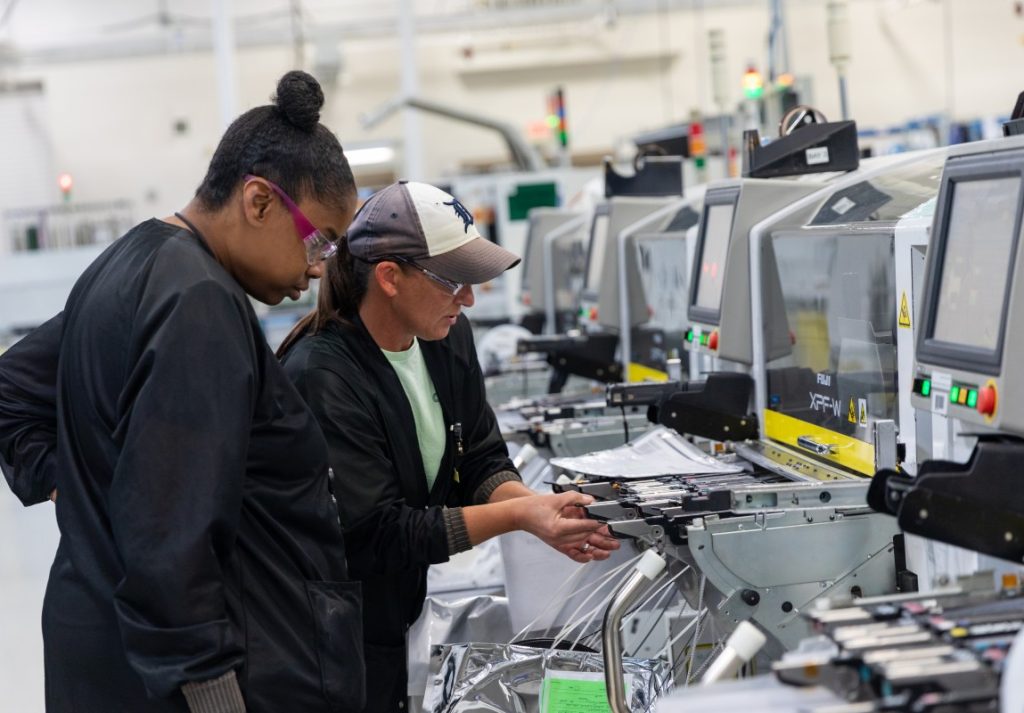
The Manufacturer’s James Devonshire speaks to Jabil’s John Kraus about how AI is reshaping manufacturing skills, and why combining digital capability with decades of practical experience will be critical to building the workforce of the future.
For years, manufacturers have warned about the growing shortage of skilled workers. But as artificial intelligence (AI) becomes increasingly embedded in factories and business operations, the nature of that skills challenge is changing. It’s no longer simply whether manufacturers can find enough tech-savvy people to operate increasingly sophisticated equipment; it is whether their existing and future workforces can adapt to a manufacturing environment in which AI sits alongside automation, connected machines and data-driven decision-making.
For John Kraus, Vice President of Operations for North America at Jabil, this isn’t an entirely new challenge. Jabil, which operates around 100 manufacturing locations and employs approximately 150,000 people globally, has been on a technology-driven capability journey for years, with AI representing the latest stage of that evolution.
“If you look at a manufacturer, we’re always on a capability journey,” Kraus said. “If you go back a couple years, it was really around the digitization of manufacturing, connecting machines, harvesting data.”
AI, he argues, is now being layered on top of that existing Industry 4.0 infrastructure. Its value is therefore not necessarily in replacing the people who work in manufacturing, but in helping them make better decisions, solve problems faster and spend more time on activities where human judgement adds the most value.
See what’s next for American manufacturing Join thousands of manufacturing leaders at Smart Manufacturing Week U.S. in Detroit, April 19–22, 2027, and discover the technologies, ideas and connections shaping the future of industry. Register your interest today ⬇️
From automation to augmentation

One of the clearest examples of this shift can be found in procurement. At Jabil, AI has taken over some of the manual work that buyers previously performed, such as releasing purchase orders through an ERP system and sending confirmations to suppliers.
That doesn’t mean the buyer has become redundant. Instead, the technology has changed where their time and expertise can be deployed. “What it’s allowed is to take that same strategic buyer and work on producing a better MPV model to benefit our customers,” Kraus explained. Buyers can spend more time negotiating minimum order quantities, addressing supplier quality issues and developing relationships with the supply base, rather than concentrating on repetitive administrative processes.
“The same individuals we’ve been able to move their attention and use their skill set to drive further value to our factories and our customers,” he said.
A similar shift is under way in quality. Rather than relying on inspectors to catch defects after the fact, Jabil is tying automated visual inspection directly back into the process step that introduces the defect in the first place, enabling real-time correction within validated parameters. “Our focus should be on FMEAs and control plans, not inspecting quality in,” Kraus said. instead of using AI simply to spot more defects faster, the goal is to prevent them occurring at all, and Kraus argues the benefits of that shift are exponential for both Jabil and its customers.
It is a useful illustration of how AI could alter the manufacturing workforce without necessarily shrinking it. As routine activities become automated, the skills that remain valuable are those that allow employees to interpret information, solve problems, manage relationships and make decisions.
The same principle applies on the factory floor. Kraus sees AI helping engineers reach better decisions more quickly and supporting technicians by identifying potential failure modes and likely problems. In turn, that can help manufacturers improve equipment reliability and extend mean time between failures. The reality is that AI literacy is becoming an additional manufacturing capability instead of a replacement for previous skills.
The old guard meets the AI generation
That creates an interesting challenge for manufacturers. If AI requires greater digital confidence, should companies recruit an entirely new generation of digitally skilled workers, or can they develop those capabilities within their existing workforce? For Kraus, the answer is a combination of the two.
Younger workers often arrive with an inherent familiarity with connected devices and digital technology. They may be more comfortable experimenting with AI and learning how to interact with increasingly intelligent systems. But that doesn’t make their experience more valuable than that of the veteran manufacturing employee who has spent decades learning how a particular process behaves. In fact, combining those two forms of knowledge can be particularly powerful.
“I see a great mix between younger talent, more mature talent coming together,” Kraus said. “I have years of industry experience meeting years of AI experience, and the outcome has been fantastic for us.”
That experience is particularly important because AI cannot necessarily tell a manufacturer everything it needs to know about a process. A technician who has spent 25 years on a production line may recognize the early signs of a problem long before it becomes obvious in the data. Rather than being displaced by AI, that worker can potentially become more valuable when their experience is combined with technology capable of identifying patterns, analyzing data and providing additional insight.
Kraus likes an analogy a colleague once shared with him: that helping older generations adopt AI is really no different to teenagers once showing their parents how to program the family’s first VCR or set up a new remote control. The technology changes, but the role of the younger generation in helping the rest of the workforce get full value out of it does not.
The challenge, therefore, is as much cultural as it is technological. Employees who have spent their careers working in one particular way may initially view AI and automation as a threat. But Kraus says attitudes can change rapidly once workers actually get the opportunity to use the technology and see how it can support their work.
That makes change management one of the defining skills of the AI-ready workforce. “Every human struggles with change,” he said. “The ability to absorb and use it on a daily basis, it’ll be surprising who really stands out in that.”
For Kraus, commitment and innovation remain important, but adaptability has risen sharply up the list of attributes he looks for in employees.
Manufacturing’s middle-management challenge
The focus of the AI skills debate often falls on operators, technicians and engineers. But one of the more difficult groups to bring along may be the managers responsible for implementing the technology.
Supervisors, production managers and operational leaders have often spent years developing established ways of running their operations. That experience can be invaluable, but it can also make it harder to embrace new approaches.
Kraus says this group requires substantial investment in AI education. Managers should take introductory courses and participate in practical training. This experience will help them understand the capabilities of the technology and the proper methods for its deployment.
“They need to be proficient in the tools, the approach, and the concept in order to lead individuals for successful implementation and utilization,” he said.
Jabil hosts innovation forums where leaders explain their use of AI and other technologies. These meetings help successful methods move from one factory to another. The goal is to identify applications that produce clear results and encourage experimentation rather than just enforcing a central technology policy. That becomes increasingly important as manufacturers attempt to scale AI across large and geographically dispersed operations.
Standardize the foundations, decentralize the innovation
Jabil’s size illustrates the scale of that challenge. With manufacturing sites serving different customers and markets, an AI application that works in one facility cannot simply be copied wholesale into another.
Kraus argues that manufacturers need to establish common foundations first. Standardized business systems, consistent processes and comparable datasets make it possible to build data lakes and applications that can be deployed across multiple sites. But standardization does not mean eliminating local autonomy.
Jabil remains highly customer-centric, and individual factories need the freedom to adapt technology to the requirements of their customers. Kraus describes this as retaining a degree of “personality” at the factory level, while ensuring the underlying infrastructure is consistent.
“It’s not about policy deployment; it’s about driving innovation and outcome,” he said.
That philosophy is also evident in how Jabil is approaching customer relationships. Instead of relying on manually prepared spreadsheets for quarterly business reviews, for example, customers and factories can increasingly connect systems and automate the exchange of information. The aim is to reduce the amount of time spent measuring and reporting and increase the time available to focus on the relationship itself.
Upskilling won’t be enough on its own
The shift towards AI also raises a familiar question for manufacturers: should they recruit people who already possess the required digital skills, or invest in retraining the workforce they have?
Again, Kraus sees a balance between the two. Jabil places a strong emphasis on retaining employees and developing their capabilities, but he argues that manufacturers cannot expect existing employees to build an entire AI strategy without the necessary specialist expertise and organizational infrastructure.
“If you have the structure, if you have the plan, and you have the approach, upskilling is definitely a way that we can move forward and enable that,” he said. “But to expect somebody who is just starting out with the technology to say, ‘Hey, I’ll be able to run this AI journey,’ that’s not appropriate.”
Kraus compares an AI transformation to starting a greenfield project. He points out that you wouldn’t hire someone without construction experience to put up a building, and the same logic applies to AI. A manufacturer needs the right foundations, processes, connections and governance before it can successfully build more advanced capabilities on top, which, in practice, means buying in certain specialist skills rather than assuming they can all be grown internally. Kraus points to AI-based program management as one example of a capability Jabil has had to bring in from outside rather than develop from scratch.
For Jabil, that means combining external expertise with internal development. The company has a tuition reimbursement program and partnerships with local educational institutions, while Kraus also sees AI as an opportunity to give existing employees new routes to develop their careers.
His own career informs that philosophy. Having started relatively low in the company and progressed through opportunities offered by Jabil, he says he wants to provide the same opportunities to others.
The education system needs to change with industry
That approach extends beyond the factory itself. If manufacturers are struggling to find the skills they need, Kraus believes they have a responsibility to become more closely involved in shaping education and training.
Jabil works with colleges and universities to help develop curricula around the technologies and capabilities that industry actually needs. Kraus says smaller trade schools and junior colleges can often be particularly nimble, working closely with employers to develop relevant programs. St. Petersburg College, close to Jabil’s own backyard, is one example: as well as helping shape curriculum, it has become a genuine recruitment pipeline, with interns who train there going on to join Jabil after connecting not just with the work but with the company’s culture. But larger universities are increasingly responding too.
At the University of Utah, for example, Jabil recently worked with the institution to develop a management certification program focused on agentic AI and related applications. The partnership emerged after Jabil identified a gap in leadership-level understanding of the technology, and the first class began within months of the initial engagement.
Jabil also works with the University of South Florida’s College of Engineering, helping shape curriculum around problems that manufacturers are encountering in the real world.
Alongside its internship programs, Jabil is also moving toward a more formal apprenticeship model, particularly on the mechanical side of the business, as it looks for more structured routes to bring young talent up through the organization.
For Kraus, these relationships shouldn’t simply serve the immediate recruitment needs of one company. Manufacturers have a responsibility to feed their knowledge back into the wider ecosystem.
“We owe it back to the communities. We owe it back to the educational institution to bring that knowledge back and say this is what brings a better worker forward for what we see in the future,” he said.
That is particularly important as US manufacturing enters a period of rapid expansion. Jabil itself is adding factories and thousands of jobs, while manufacturers across the country are competing for a limited pool of digitally capable talent.
Manufacturing has a new talent proposition
The competition for those workers isn’t just between manufacturers. Technology companies, logistics businesses and other sectors are also looking for people with digital skills. This reality means manufacturers need to rethink how they present themselves to potential employees.
Kraus believes culture is one of Jabil’s biggest advantages. The company emphasizes community involvement and employee empowerment, while offering opportunities for people to move between functions, regions and even countries. Tuition reimbursement provides another route for employees to develop their skills.
“We’re building careers. Anybody can have a job. I want to give you a career,” Kraus said.
There is also the attraction of working with technology at the cutting edge. As a contract manufacturer supporting some of the world’s largest companies, Jabil gives employees exposure to new designs and technologies that they might not encounter elsewhere. That could help manufacturing overcome one of its most persistent recruitment problems, which is the outdated perception of what factory work actually looks like.
The modern factory is increasingly a highly connected environment involving automation, data, software, advanced inspection and AI. For younger workers who have grown up surrounded by digital technology, that can make manufacturing considerably more attractive than the traditional image of the factory.
Don’t put AI on top of a broken process
For manufacturers only beginning their AI journey, however, Kraus has a warning: don’t start with the technology. “The first thing is you invest in your strategy,” he said. Manufacturers need to establish what they are trying to accomplish and then work backwards to determine the milestones, capabilities and workforce required to get there.
There are relatively straightforward applications that manufacturers can adopt today. AI-powered cameras, for example, can identify unsafe practices and automatically report them, while thermal monitoring can detect anomalies in applications such as battery manufacturing and provide an early warning. But more advanced applications, such as using AI to control and adjust an entire manufacturing process, require greater maturity.
Before getting there, manufacturers need to simplify and standardize their processes. “The worst thing you can do is have a process that’s not operating in control and try to layer more and more technology on top of that to drive control in,” Kraus said.
It is perhaps one of the most important points in the entire AI debate. Technology cannot compensate indefinitely for poor processes. The manufacturers most likely to benefit from AI are those that first understand what their processes are supposed to achieve, establish reliable foundations and then use technology to take performance to the next level.
Embracing the unknown
Ultimately, Kraus believes one of the biggest barriers to AI adoption is people’s perception of the technology’s complexity.
“Everybody is afraid of the unknown,” he said. His approach is therefore to make experimentation accessible. Kraus has, in the past, set engineers technical challenges entirely unrelated to manufacturing, such as building something with five axes of movement on a 3D printer, with dinner on offer for the winner, simply to get people comfortable playing with new technology. He is applying the same logic to AI. Challenge people to use it, understand it, and let curiosity do the rest, rather than allowing apprehension to prevent them from engaging with it.
That philosophy captures the broader change taking place across manufacturing. The AI-ready workforce isn’t necessarily a completely new workforce filled with data scientists and software engineers. Nor is it a workforce in which experienced operators and technicians are pushed aside by automation.
Instead, it is a workforce in which different generations and different forms of expertise are combined. Decades of manufacturing knowledge alongside digital confidence, human judgement alongside machine intelligence, and established processes alongside a willingness to change them.
For manufacturers facing the next stage of the Industry 4.0 journey, the challenge may therefore be less about finding people who already possess every skill they need, and more about creating organizations in which people are equipped and encouraged to learn what comes next.
Never miss a North American manufacturing story
Sign up for our free weekly North American Manufacturing Digital Briefing to receive the latest industry news, insights and analysis direct to your inbox every Monday.